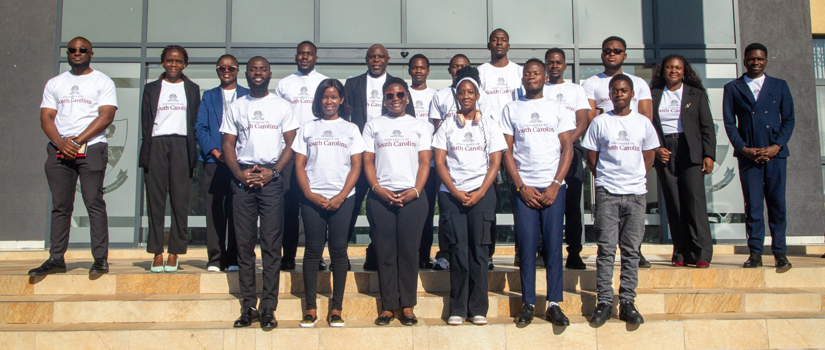
Teams develop strategic recommendations for HATTAZ, advancing global learning through applied consulting and cultural collaboration.
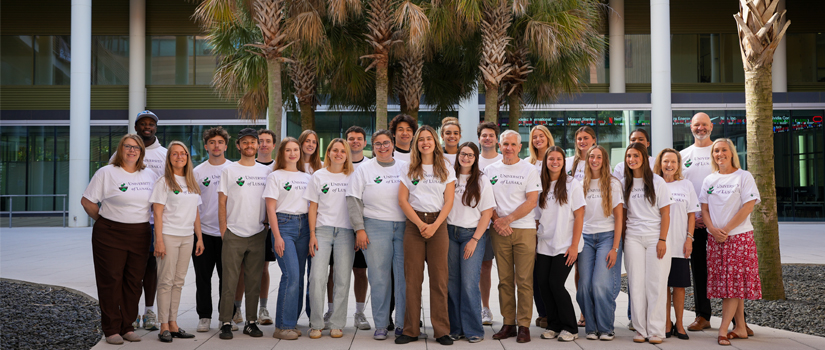
The Darla Moore School of Business's International Marketing course set out to tackle a real-world consulting project this semester. Students quickly discovered that successful international business requires more than marketing expertise—it requires meaningful engagement across cultures, perspectives and continents.
Twenty-three students from the Master of International Business (MIB) program, including accelerated International Business/MIB undergraduates, partnered with 18 students from the University of Lusaka in Zambia to support HATTAZ (Handloom and Textiles Technologies Association of Zambia), an organization dedicated to empowering textile artisans through handloom weaving, cotton value addition and improved market access for locally produced fabrics and apparel.
International Business faculty member, Kristine Laca incorporated HATTAZ into her international marketing coursework. This opportunity gives students the chance to advance their collaboration skills while solving a real-world business challenge.
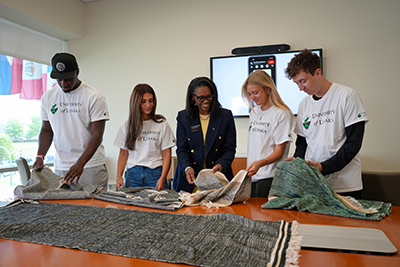
Working in six multinational teams, students developed recommendations addressing key international marketing challenges, including brand positioning, communications strategies, government support opportunities, market access and expansion into new international markets.
The project allowed students to apply classroom concepts to a meaningful business challenge while engaging directly with peers from another country.
“Collaborating with the University of Lusaka on the HATTAZ consulting project has been nothing short of transformational, both personally and professionally,” says MIB student Julia Austin. “Working with incredible people to tell the story of incredible women was such a powerful experience, and I am eternally grateful for the opportunity to have grown alongside my UNILUS counterparts in our understanding of each other's culture and business practices.”
For many students, the experience highlighted the importance of cross-cultural teamwork and communication. Through virtual meetings, collaborative research and strategy development, participants learned how diverse perspectives can strengthen business solutions.
“Working alongside students from the University of Lusaka was one of the most rewarding parts of this experience,” says MIB student Cara Cheatham. “Getting to collaborate with teammates from a different background pushed me to communicate more intentionally and really value different perspectives.”
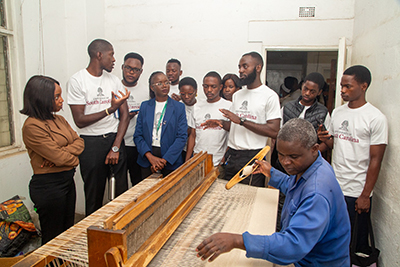
MIB student Daria Volkova reflected on the collaborative nature of the project, saying, “You don't need a big budget to make a big impact. You need a shared vision, open ears, and the courage to co-create across continents. That's what the HATTAZ project gave me.”
The partnership also offered students a deeper understanding of Zambia's textile industry and the social impact of organizations like HATTAZ, which creates economic opportunities for women and youth through traditional craftsmanship.
“Finding strategies to support a community-driven business like HATTAZ, while helping the weavers’ stories be seen and heard, has been such a meaningful experience,” says MIB student Natalia Watson. “Thank you to HATTAZ leadership, the University of Lusaka, and the Darla Moore School of Business for challenging me and pushing me to keep growing and learning.”
Students from the University of Lusaka echoed similar sentiments about the benefits of working across cultures.
“My experience on the HATTAZ project showed me that cross-cultural collaboration leads to stronger ideas, more effective teamwork, and meaningful personal growth,” says University of Lusaka student Emma Gondwe. “It was an inspiring journey that broadened my perspective.”
The project also deepened students' appreciation for Zambia's rich textile traditions and artisan craftsmanship. University of Lusaka student Webster Sichilima reflected on the cultural significance of the work, saying, “Every design tells a different story, reflecting the emotions and experiences of the weaver throughout the process.”
University of Lusaka student Tekela Simbao noted that the project demonstrated how cultural exchange can foster innovation. “It strengthened my teamwork skills and showed how cultural exchange can enhance creativity and innovation,” Simbao says.
Beyond marketing recommendations, participants emphasized the personal and professional relationships formed throughout the project. Students worked through differences in communication styles, business approaches and cultural perspectives to develop solutions that reflected both local realities and global opportunities.
“It’s not every day you go to class and create a real, visible impact,” says MIB student Grace Geer. “This project allowed us to apply our degree in a real-world setting while creating positive social impact, supporting a meaningful organization, operating within a developing market context, and exercising cross-cultural communication.”
Students in Kristine Laca’s IBUS 502 International Marketing class recently completed a second exchange project with University of Lusaka students. In this exchange, University of South Carolina students developed strategic market-entry plans for Lusaka, Zambia, while Lusaka students developed market-entry strategies for Columbia, South Carolina.
South Carolina and Lusaka students were paired so that each group served as local-market experts for their collaborator. This created an opportunity for cultural learning and exchange, including a deeper understanding of how local context shapes international marketing decisions.
These opportunities reflect the Darla Moore School's commitment to providing students with applied international business consulting experiences that extend beyond the traditional international marketing classroom. Rather than studying global business solely through case studies, students work directly with international organizations to solve real business challenges as they develop cross-cultural communication, strategic thinking and global leadership skills needed to succeed in today's interconnected economy.
The HATTAZ project builds on the Moore School’s broader commitment to experiential international business education.
Other recent consulting projects in Kristine Laca’s IBUS 402 International Marketing classes have included partnerships with the Black Rhino Protection Fund and Namibia Wildlife Protection, where students developed marketing communications, digital outreach strategies and fundraising initiatives—including messaging frameworks, website concepts and brand-positioning tools designed to produce immediately usable client content.
IBUS 402 students have also worked with Tree Monkeys in South Africa, creating digital marketing content to promote nature-based sustainable tourism centered on indigenous trees and ecosystems. That project also included collaboration with the USC Arboretum to better understand visitor behavior and the psychographics of nature enthusiasts.
Together, these projects give students the opportunity to create practical, client-focused recommendations while gaining firsthand experience navigating the complexities of global business.
The HATTAZ consulting project was launched under a newly established Memorandum of Understanding (MOU) between the universities, giving students the opportunity to contribute to a broader institutional partnership while addressing a meaningful international business challenge.
The partnership traces its roots to CIBER’s Faculty Development in International Business (FDIB) Africa program in 2025, where Marki Jones, alongside representatives from the U.S. Embassy in Zambia, facilitated an engagement with University of Lusaka leaders and stakeholders. Dr. Deb Hazzard participated in the visit and developed an immediate connection with Lusaka educators, which led to an unplanned visit to the university's campus to tour the facilities and explore opportunities for future collaboration.
Following the visit, Hazzard remained in close contact with University of Lusaka colleagues through monthly virtual meetings to explore opportunities for collaboration, ultimately leading to the development of the Memorandum of Understanding (MOU). She now serves as the faculty lead for the partnership.
The agreement, approved by the University of South Carolina Board of Trustees, establishes a framework for future collaboration in student and faculty exchanges, joint research, curriculum development, industry engagement, executive education and other academic initiatives.
The International Marketing consulting project with HATTAZ is the first collaborative initiative launched under the agreement and serves as a model for future partnerships between the two institutions. The project also highlights the impact of CIBER programs in creating opportunities for faculty engagement, international partnerships and meaningful global learning experiences for students while strengthening the Moore School’s global connections.
As Bruce Mwembya of the University of Lusaka reflected, “Each of us is a unique drop, but together we form an ocean of resilience. Our collective effort proved that even demanding processes can produce meaningful outcomes when cooperation binds us.”
For the students involved, the experience served as a reminder that international marketing is ultimately about connecting people, sharing stories, building lasting partnerships and creating opportunities that extend far beyond the classroom.