
Heart defects affect about 1 percent of all babies born in the United States each year. Stephanie Schaller, an assistant professor at the University of South Carolina College of Nursing, says this small percentage amounts to a big number — around 40,000 births.
“If you’re going to be working in pediatrics or in the ER, you’re going to encounter a child with some type of heart defect or heart failure,” Schaller says. “Being able to understand those signs and symptoms — and what to do in those situations — is important. That’s why it’s in the curriculum for all Bachelor of Science in Nursing students.”
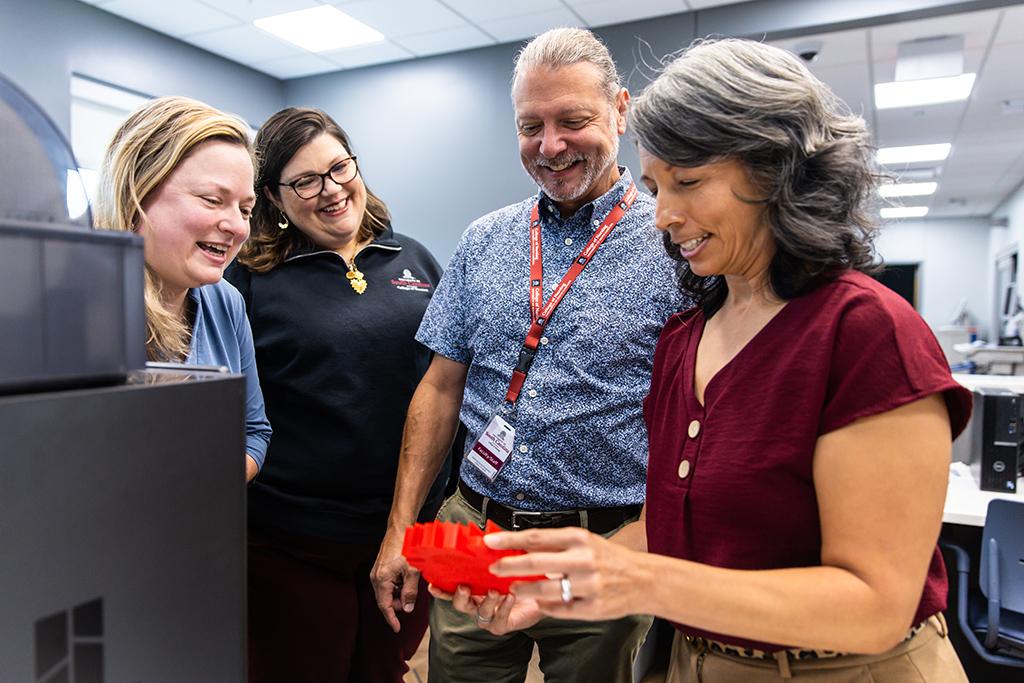
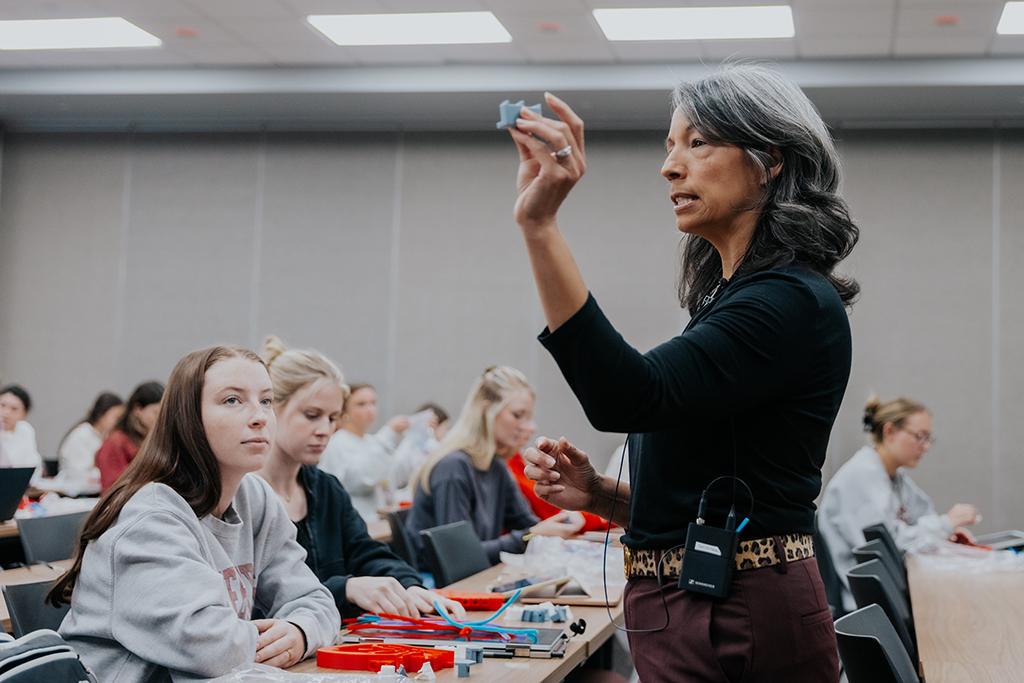
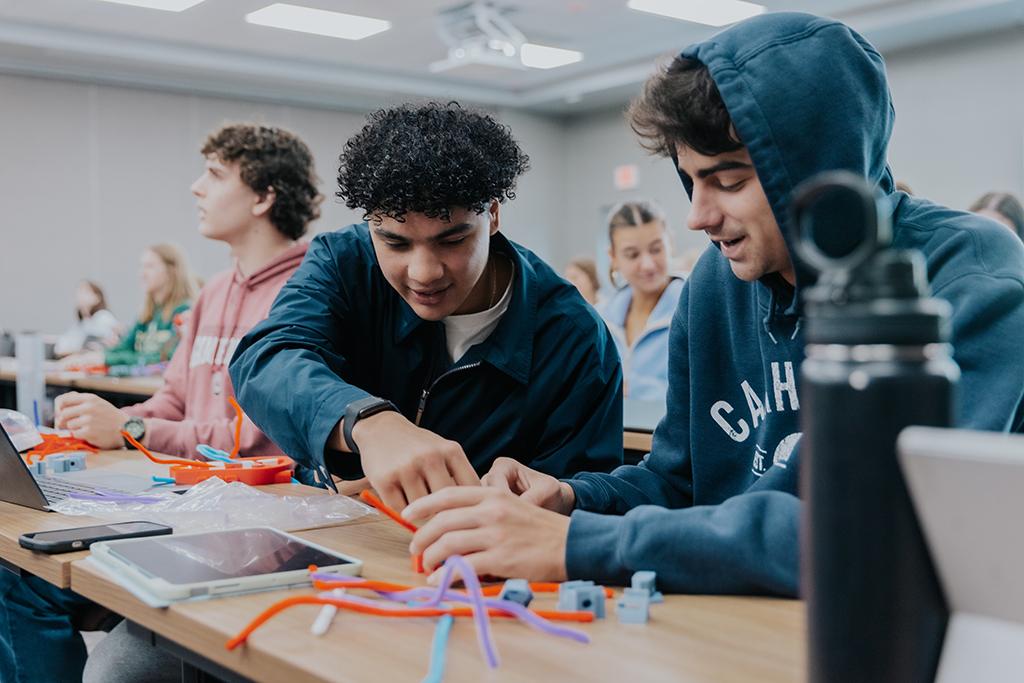
To help students more effectively master this material, Schaller invented a new tool that lets students learn heart defects through hands-on activities. CardioEducatorTM is now in use at both USC Columbia and USC Upstate and was recognized by the 2025 South Carolina InnoVision Awards as a finalist in the education category.
“At the College of Nursing, innovation is at the heart of everything we do, from education and research to clinical practice. We’re not simply adapting to change; we’re defining it. Dr. Schaller embodies this forward-thinking spirit through CardioEducator, transforming once-abstract concepts into tangible insights,” says Dean Jeannette Andrews.
Developing CardioEducator
Schaller has been teaching the College of Nursing’s pediatrics course since 2022. She joined the faculty after graduating from the college with her Doctor of Nursing Practice — her third nursing degree from USC. A pediatric nurse practitioner with 16 years of experience, Schaller soon found that the cardiovascular unit wasn’t clicking in a traditional lecture format.
“When you’re learning about the heart, you’re thinking about all these different elements, and students can get overwhelmed,” she says. “You add in different heart defects, and it gets even more complex and difficult for them to understand.”
What makes it harder to parse out is that the baby’s heart changes structurally soon after being born. While still a fetus, the baby doesn’t need to breathe. The heart bypasses the lungs until birth.
“When that baby is born and takes its first breath, all the pressure changes, which makes all those bypasses go away — at least, we hope they go away,” Schaller says.
Sometimes, something goes wrong in the transition: a valve doesn’t open completely, or a baby has a small hole in the heart. Knowing the signs of a defect allows practitioners to intervene quickly. Since a nurse is often the first one to examine a patient, Schaller started looking for a better way to teach the material. She wasn’t going to let her students leave her class without a solid understanding of the topic.
“I was trying to find a heart model that we could use to learn hands-on, but I have to teach the fetal heart, the newborn heart and five different defects. I couldn’t find any one model that had all the defects, and each model cost hundreds of dollars,” she says. “That was when I had the idea to 3D print my own educational tool.”
Schaller imagined a model of the heart with interchangeable, puzzle-like pieces that would help her students visualize the baby’s cardiovascular system with and without defects. Working with College of Nursing colleagues, Schaller developed a prototype in 2023, and CardioEducator was born.
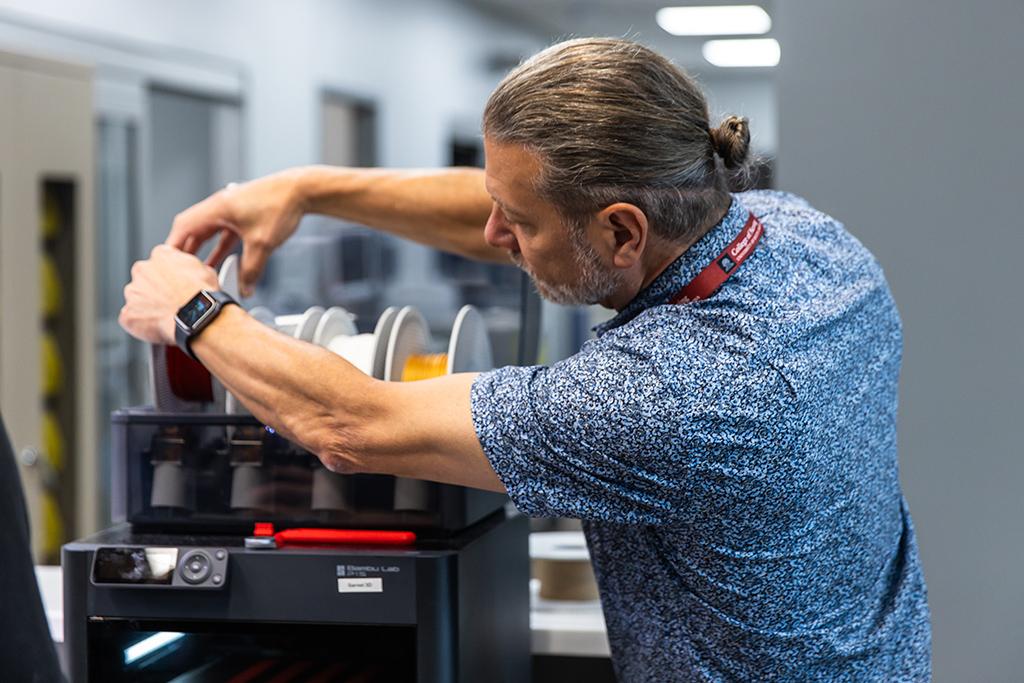
Dean Andrews encouraged Schaller to apply for the Helen Gurley Wolford Teaching Grant, which made it possible for Schaller to purchase two 3D printers for use in the Center for Simulation and Experiential Learning. They made the first batch of CardioEducators in 2024, allowing USC Columbia nursing students to use the models in class that spring.

Launching NursEdvance Innovations
Schaller is also researching the tool’s impact on student learning. Shortly after presenting her findings at a conference last winter, Schaller met Tamara Cook, an associate professor at the Mary Black College of Nursing at USC Upstate. Cook also teaches the pediatrics course and was facing the same challenge with her students.
“I’ve taught this course for 12 years, and the recurring issue is that students don’t understand the concept of blood flow during defects. They could memorize the symptoms, but they were still struggling with the concept,” says Cook, a family nurse practitioner who earned her Doctor of Nursing Practice from USC Columbia in 2017.
The two professors talked at length, and that conversation led to an idea that Schaller had only just begun to consider: “I told her that I’d need to work with my dean, but I would love to get some funding to purchase a set of models for my class,” Cook says.
To make this possible, Schaller approached the Technology Commercialization Office, and with additional support from the South Carolina Small Business Development Center, she established her own business — NursEdvance Innovations, LLC — to sell a batch of CardioEducators to USC Upstate in 2025.
Cook used the models in her class for the first time last month. She found that using the tool required her to change the order of her lecture to align with Schaller’s approach, but student feedback was positive overall.
“During the lesson with the models, there was a student that I happened to catch her face when it clicked,” Cook says. “You could see it on her face that she got it because she was doing it herself — because she had to figure it out.”

Cook says she is thankful that Schaller came up with this teaching solution.
“For her to think about new ways to present this material so that students can understand it better for their success, it means a lot to me. I believe this is a foundation for the work that can be done through USC campuses collaborating.”
Schaller is also excited to have Cook contribute to her research, and she hopes to see the business sell to other universities in the future. In addition, her new LLC isn’t limited to the CardioEducator. With an additional grant from USC Nursing, Schaller is developing an AI-enhanced study tool for nursing and health students. She’ll present CardioEducator and her new educational tool at the national 2025 Transform conference next month, where several other nursing faculty members will also showcase their inventions and new products to enhance nursing education and practice.
Andrews says innovation is essential to the college’s mission, and faculty members are the driving force behind this work. That’s why supporting innovation is so important.
“Through initiatives like the Innovation in Teaching grants, we’re proud to support leaders like Dr. Schaller, who bring new ideas and energy to nursing education at the University of South Carolina,” she says.
What Schaller appreciates most about being on faculty at the college is the ability to expand her work through creativity and collaboration with her colleagues in a supportive atmosphere. Above all, she’s thankful for the opportunity to give back to the nursing profession.
“I am always looking for ways to engage my students and solve problems which means I’m also thinking up new ideas,” Schaller says. “And Dean Andrews has been incredibly supportive. I’m so grateful for the grants the College of Nursing provides to teaching faculty members to find and create educational tools. That speaks to the kind of culture we have here.”